

Michigan's Move Over Law: Rules for Emergency Vehicles Explained
Confused about when you need to 'move over'? What Michigan law says about emergency vehicles is clear. Learn the rules to avoid fines and protect lives.
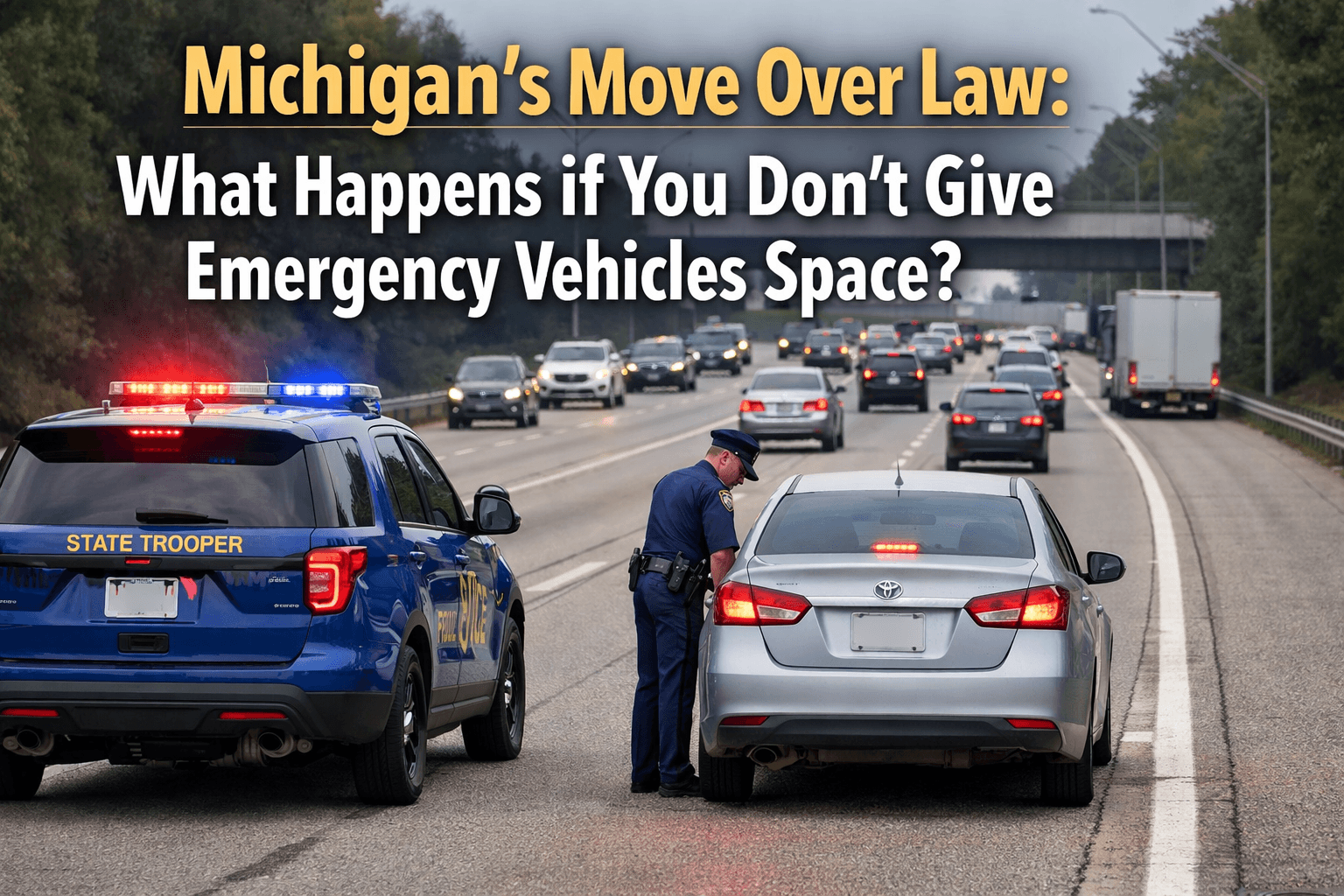
Seeing flashing lights on the side of a Michigan highway triggers a critical question for every driver: when do I need to 'move over'? What Michigan law says about emergency vehicles is not a suggestion, but a strict mandate designed to protect lives.
Understanding this rule is essential for road safety in Michigan.
The core of Michigan's Move Over law is straightforward but often misunderstood.
Drivers are required to slow down by at least 10 mph below the posted speed limit.
You must also move over one full lane, creating a crucial buffer of space for the stationary vehicle.
This isn't just for police units, fire trucks, and ambulances.
The law extends protection to a wide array of roadside workers, including tow trucks, utility service vehicles, road maintenance crews, and even solid waste collection vehicles with their lights activated.
The consequences for ignoring this law are severe.
A basic violation is a civil infraction that can cost you $400 and add two points to your driver's license.
However, the penalties escalate dramatically if someone gets hurt.
If failing to move over causes an injury to an emergency responder or roadside worker, it becomes a felony.
That carries a potential fine of up to $1,000 and two years in prison.
The most tragic outcome—causing a death—can result in a felony charge with a fine up to $7,500 and a staggering 15 years behind bars.
It's a stark reminder that a moment of inattention can have life-altering repercussions.
While the law specifically applies to vehicles with flashing lights, officials with the Michigan State Police urge drivers to use caution around any vehicle stopped on the shoulder.
A simple act of caution can prevent a disaster.
Providing extra space is always the safest course of action, whether legally required or not.
The law exists because roadside stops are one of the most dangerous situations for first responders and workers.
Your decision to move over directly impacts their safety.
What is the fine for not moving over in Michigan? The base fine for a violation is $400, but it can increase to $1,000 for causing an injury or up to $7,500 for causing a death, along with potential jail or prison time.
Do I have to move over for a tow truck in Michigan? Yes, if a tow truck or other road service vehicle has its emergency lights flashing, you are required by law to slow down and move over one lane.
How much do I need to slow down for an emergency vehicle in Michigan? You must reduce your speed by at least 10 mph below the posted speed limit, in addition to moving over a lane if possible. |
Stay up to date with our local news!
Get articles like this delivered to your inbox.
Subscribe Now
Sep 9, 2026
Tower of Power at FireKeepers
Holiday and Hits Tour arrives Dec. 10.
Sep 9, 2026
Battle Creek home fire reported
Official details remain pending.

Sep 9, 2026
One Final Meal at Clara’s on the River | Cereal City Buzz
A firsthand look at one final meal at Clara’s on the River in Battle Creek, including the food, service, memories and what may come next.

Sep 9, 2026
27 26th St N Battle Creek Home | Cereal City Buzz
Explore a $225,000 Lakeview home at 27 26th St N in Battle Creek with 3 bedrooms, hardwood floors, a fenced yard, garage, and no HOA.
0 Comments
Join the conversation
Be the first to comment
Share your thoughts above.