

Teens and Artificial Intelligence in Michigan
Exploring the role of AI in education and student use of chatbots
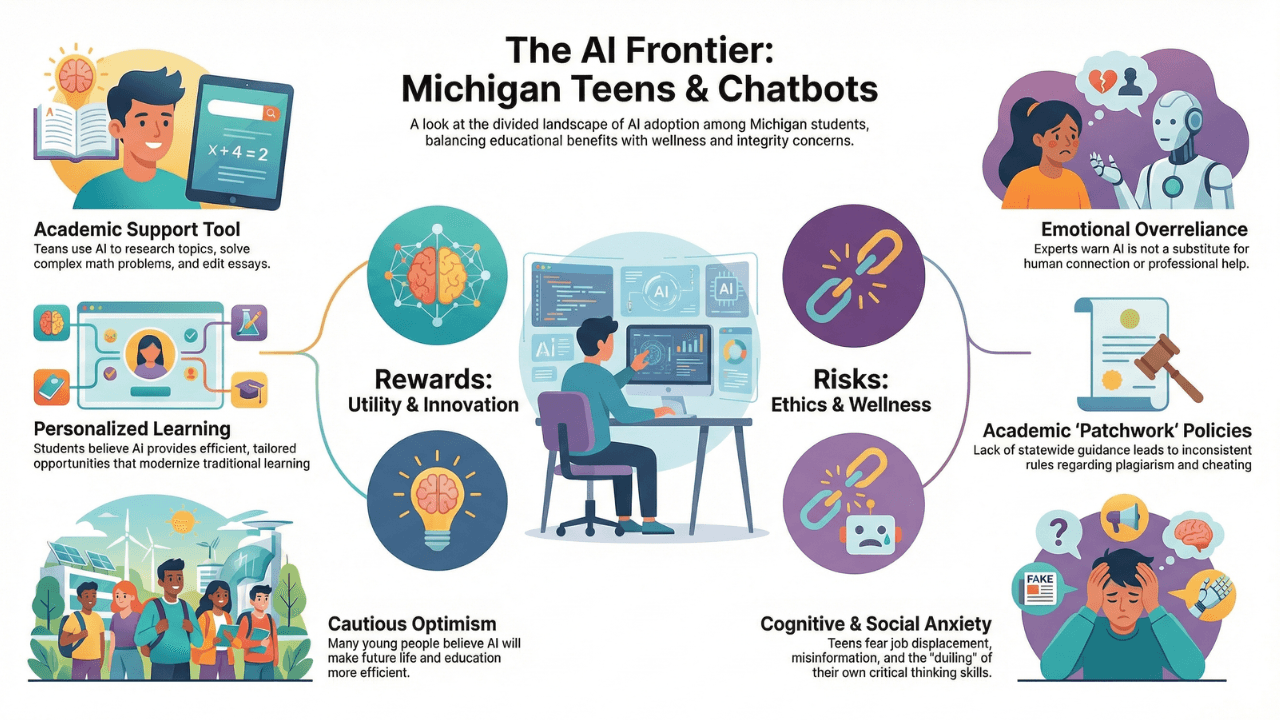
In classrooms from Detroit to the Upper Peninsula, a quiet revolution is underway, and it's powered by artificial intelligence.
For many Michigan teens, AI chatbots are becoming as essential to homework as a laptop or a textbook, fundamentally changing how they learn, write, and even think.
This rapid adoption is creating a complex new reality for students, parents, and educators across the state.
Recent national reports reflect what many local teachers see every day: a majority of students are now using AI tools to help with their schoolwork.
This ranges from researching topics and solving math problems to editing essays.
While many see these tools as helpful, a shadow of concern looms large.
A significant number of teens believe their peers are using AI for one simple reason: to cheat.
This puts school districts in a difficult position, forcing them to define the blurry line between a helpful resource and academic dishonesty.
The Michigan Department of Education encourages local districts to create their own policies, leading to a patchwork of rules that can vary from one school to another.
Some districts are embracing AI as a powerful learning assistant, while others are blocking access over plagiarism concerns.
It’s a debate that is far from settled, leaving many students and teachers in a state of uncertainty.
But the use of AI by teens extends well beyond the classroom walls.
A growing number are turning to these sophisticated programs for entertainment, conversation, and even for emotional support.
While a small percentage of teens report using chatbots for advice, the trend has child wellness advocates deeply concerned.
Experts at institutions like the University of Michigan have warned that these platforms are not substitutes for human connection and can sometimes reinforce harmful behaviors or prevent teens from seeking real help.
The technology is so new that its long-term impact on teen mental health is a major unknown, creating a sense of urgency for parents to stay involved.
Parental supervision, experts argue, is more critical than ever.
Just like any powerful technology, the lack of oversight can lead to unforeseen risks.
When asked about the future, Michigan's young people have mixed feelings.
Many are cautiously optimistic, believing AI will make life more efficient and open up new learning opportunities.
However, others express legitimate fears about job displacement, the spread of misinformation, and a potential overreliance on technology that could dull critical thinking skills.
Some believe the most honest answer is simply, “we don’t know.”
Educational leaders say that despite the risks, the key is not to fear AI, but to approach it with caution and a healthy dose of skepticism.
Learning the strengths and limitations of these incredible new tools is now a critical skill for the next generation of Michiganders.
Q&A: The AI Shift in Michigan Schools
How is the Michigan Department of Education (MDE) managing the rise of AI in local classrooms? The MDE has opted for a decentralized approach. Rather than mandating a single statewide rule, they encourage local school districts to develop their own individual policies. This has resulted in a "patchwork" of regulations across the state, where one district might integrate AI as a core learning tool while a neighboring district might ban it entirely to prevent plagiarism.
Beyond academic cheating, what is the primary concern for teen wellness experts at Michigan institutions? Experts, including those at the University of Michigan, are increasingly worried about "emotional overreliance." While many teens use chatbots for entertainment, a growing number are seeking emotional support or life advice from these programs. Advocates warn that AI is not a substitute for human connection and could potentially reinforce harmful behaviors or discourage teens from seeking professional, real-world help.
What do Michigan students identify as the biggest risks and rewards of this technology? The outlook is a mix of "cautious optimism" and "legitimate fear." The Rewards: Teens believe AI will increase efficiency, provide personalized learning opportunities, and act as a powerful research assistant. The Risks: There is significant anxiety regarding job displacement in the future, the spread of misinformation, and a concern that overreliance on chatbots might "dull" the critical thinking skills necessary for their development. |
Stay up to date with our local news!
Get articles like this delivered to your inbox.
Subscribe Now
Sep 9, 2026
Tower of Power at FireKeepers
Holiday and Hits Tour arrives Dec. 10.

Sep 9, 2026
Battle Creek home fire reported
Official details remain pending.

Sep 9, 2026
One Final Meal at Clara’s on the River | Cereal City Buzz
A firsthand look at one final meal at Clara’s on the River in Battle Creek, including the food, service, memories and what may come next.

Sep 9, 2026
27 26th St N Battle Creek Home | Cereal City Buzz
Explore a $225,000 Lakeview home at 27 26th St N in Battle Creek with 3 bedrooms, hardwood floors, a fenced yard, garage, and no HOA.
0 Comments
Join the conversation
Be the first to comment
Share your thoughts above.