

5 Ways the Trump Administration Reshaped Michigan in 2025
An analysis of how the Trump administration reshaped Michigan in 2025 through tariffs, immigration policy, federal funding cuts, and education changes.
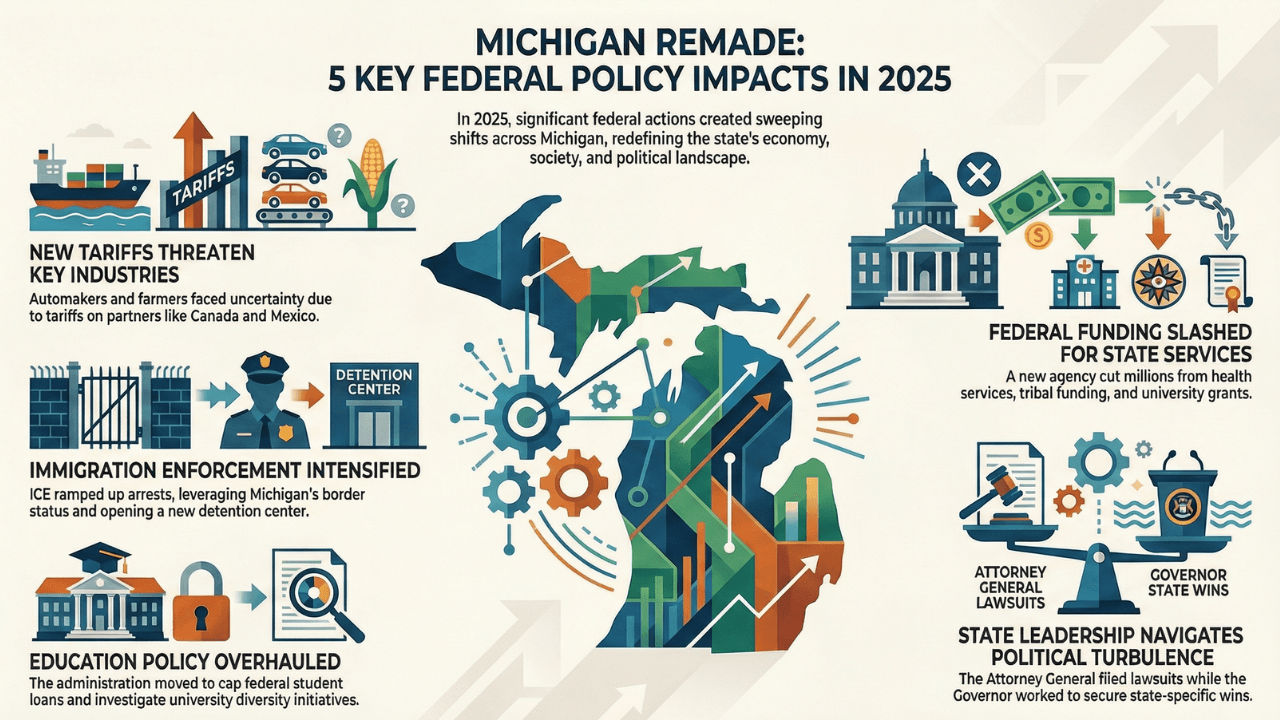
A year of seismic shifts has concluded, leaving a profoundly altered landscape across the state.
The second term of President Donald Trump promised a tide of change, and for Michigan, that promise has been delivered through a series of sweeping actions.
Here are five key ways the Trump administration reshaped Michigan in 2025.
First, economic shockwaves hit the state’s most vital industries.
New tariffs on global trading partners, including Canada and Mexico, created widespread uncertainty for automakers like General Motors and Ford.
Business leaders and farmers alike have warned of rising costs and potential job losses, a direct consequence of the administration's aggressive trade posture.
Second, immigration enforcement has been dramatically intensified.
Fulfilling a campaign promise, U.S. Immigration and Customs Enforcement (ICE) ramped up arrests across Michigan, leveraging the state’s unique status as a northern border zone.
The opening of a massive new detention center in Lake County underscores the administration's focus, sparking fierce debate among advocacy groups.
Third, a federal restructuring effort led to significant funding cuts.
The short-lived Department of Government Efficiency (DOGE) clawed back millions from the state, impacting everything from health services to tribal funding.
Institutions like Michigan State University reported losing tens of millions in grants, while the dismantling of the Department of Education created new challenges for student loan borrowers.
Fourth, education policy itself was a major target for change.
The administration moved to cap federal student loans and launched investigations into diversity initiatives at universities across Michigan.
These moves were framed as returning power to the states, but critics argue they undermine educational access and equity.
Finally, the federal policy shifts have reshaped Michigan's own political dynamics.
Attorney General Dana Nessel has repeatedly challenged the administration in court, filing dozens of lawsuits.
Meanwhile, Governor Gretchen Whitmer has navigated a more delicate relationship, attempting to secure wins for the state, such as a new mission for the Selfridge Air National Guard Base, amidst the turbulent political climate. |
Stay up to date with our local news!
Get articles like this delivered to your inbox.
Subscribe Now
Sep 9, 2026
Tower of Power at FireKeepers
Holiday and Hits Tour arrives Dec. 10.

Sep 9, 2026
Battle Creek home fire reported
Official details remain pending.

Sep 9, 2026
One Final Meal at Clara’s on the River | Cereal City Buzz
A firsthand look at one final meal at Clara’s on the River in Battle Creek, including the food, service, memories and what may come next.

Sep 9, 2026
27 26th St N Battle Creek Home | Cereal City Buzz
Explore a $225,000 Lakeview home at 27 26th St N in Battle Creek with 3 bedrooms, hardwood floors, a fenced yard, garage, and no HOA.
0 Comments
Join the conversation
Be the first to comment
Share your thoughts above.